

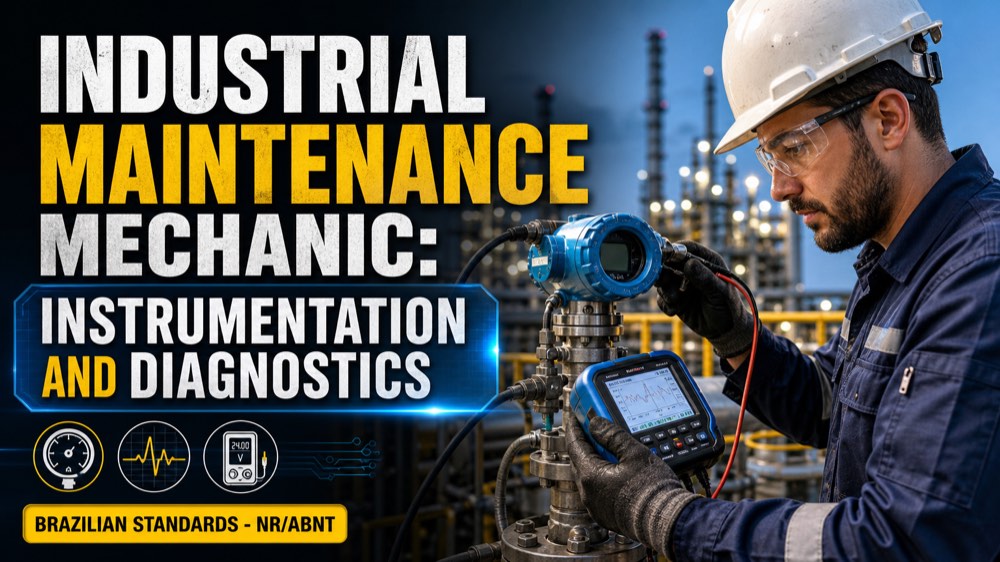
Industrial Maintenance Mechanic: Instrumentation and Diagnostics
IntermediateContent based on Brazilian standards (Ministry of Labour Regulatory Norms and ABNT). Industrial Maintenance Mechanic: Instrumentation and Diagnostics is the third course in a five-course series for anyone who wants to work as a maintenance mechanic in industrial plants. If you haven't yet taken the Introduction to Industrial Maintenance course, we recommend starting there first, since this course assumes familiarity with the fundamentals covered in it. Here you will master the precision measuring instruments used daily in maintenance work — calipers, micrometers, and dial indicators — and learn to read their measurements confidently while respecting dimensional tolerances specified on technical drawings. You will also learn shaft alignment techniques (parallel and angular), machine leveling, rotor balancing, and basic vibration analysis, skills essential for reducing premature failures in motors, pumps, and gearboxes. Finally, the course introduces a structured fault-diagnosis method, including the 5 Whys technique and the Ishikawa diagram, so you can identify a problem's root cause instead of just treating the symptom. By the end, you will be able to measure, align, balance, and diagnose with the technical rigor required in real industrial environments.
Course content
Certification Exam
Certification Exam
Industrial Maintenance Mechanic: Instrumentation and Diagnostics
🔒 Unlock the exam
Complete the requirements above to unlock the exam
Certification Exam
Industrial Maintenance Mechanic: Instrumentation and Diagnostics
30 Questions
All difficulty levels
45 Minutes
Auto-submits when time expires
70% to Pass
Earn your certification badge
No Going Back
Once you answer, you move forward
Tips
See allSwapping the Part Is Not the Fix
A replaced part fails again if the cause is still there
Sort Causes Into the 6 Ms
Method, manpower, material, machine, measurement, environment
Ask Why Five Times
Keep drilling past the obvious first answer
Trust the Trend, Not One Reading
A rising curve warns you long before a threshold does