Portuguese for Public Service Exams
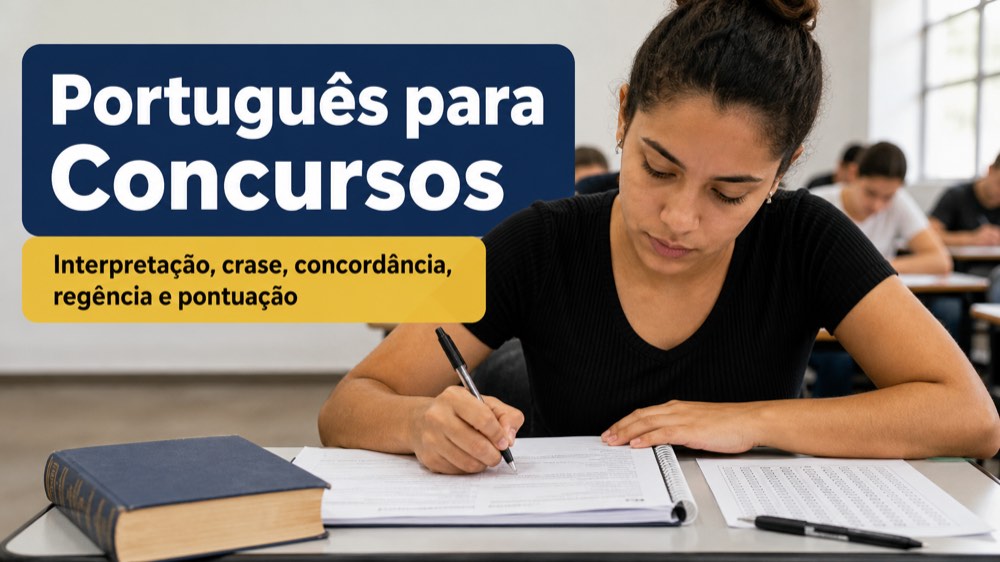
This course is for Brazilian public service exams (concursos públicos) and the lessons are taught in Portuguese. Portuguese is the subject that weighs the most in most Brazilian public service exams, and also the one that trips up well-prepared candidates in the rest of the syllabus. This course is for anyone taking a mid-level or higher-education exam who feels school grammar is far behind. It starts from the basics, without assuming you remember the rules, and goes straight to what the exam boards test. Part one is Reading comprehension: the difference between understanding and interpreting, main idea, inference, presupposition and implicature, and how the board wording changes what the question asks. Part two is Spelling and accent marks: the rules of the current Orthographic Agreement, what changed with the end of the diaeresis and some accents, hyphens in the most tested cases and the reasons behind them. Part three is Agreement and verb government: postposed subject, impersonal verbs such as haver and fazer, the particle se, and the verbs and nouns that require a preposition, such as assistir, visar and obedecer. Part four is Crase and punctuation: when crase is mandatory, forbidden or optional, and the comma uses that show up most in exams, including the forbidden comma between subject and verb. The last part is Word classes and sentence structure: the classes the exam explores, such as pronouns, conjunctions and adverbs, and how coordinate and subordinate clauses connect. Each lesson ends with an exam-board-style question, true or false and multiple choice, solved step by step, always by the current standard norm.