
Cybersecurity Fundamentals
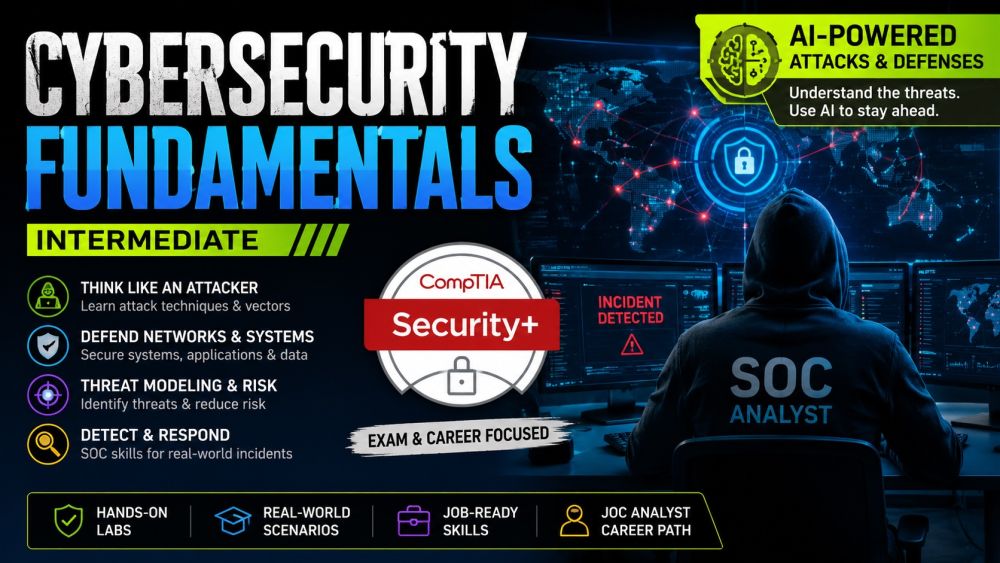
IntermediateBuild job-ready cybersecurity skills aligned with CompTIA Security+ and the SOC analyst career path. Learn how attackers think, how to defend networks and systems, how to model threats and assess risk, and how to detect and respond to incidents in a security operations center. A dedicated track on AI-powered attacks and defenses prepares you for the threats reshaping the field right now โ so you can pass the cert and step into a security role with confidence.
Videos
See allTracks
Start with the bedrock of cybersecurity: the CIA triad (confidentiality, integrity, availability), authentication and access control, and the principle of least privilege. Map the modern threat landscape โ malware families, phishing and social engineering, insider threats, and common vulnerabilities. Learn the attacker mindset and the security vocabulary that the rest of the course (and the Security+ exam) builds on.
Defend the infrastructure attackers target. Learn how firewalls, VPNs, IDS/IPS, and network segmentation work together, and how protocols like TCP/IP, DNS, and TLS are both used and abused. Cover endpoint hardening, patch management, secure configuration, and cryptography fundamentals โ symmetric vs asymmetric encryption, hashing, and PKI. Build the practical defensive skills that keep systems resilient under attack.
Think like an architect of defense. Learn structured threat modeling with STRIDE, attack trees, and the MITRE ATT&CK framework to map how systems can be compromised before attackers do. Master risk assessment โ likelihood, impact, and risk appetite โ and translate findings into prioritized controls. Cover governance, compliance frameworks, and how to communicate risk to decision-makers in language they act on.
Step into the security operations center. Learn how SOC analysts use SIEM tools, logs, and alerts to detect intrusions, triage events, and cut through false positives. Walk the full incident response lifecycle โ preparation, detection, containment, eradication, recovery, and lessons learned. Practice threat hunting, digital forensics basics, and the documentation discipline that turns chaos into a controlled response.
AI has changed both sides of the fight. Understand how attackers use AI for hyper-realistic phishing, deepfakes, automated reconnaissance, and adaptive malware โ and the new risks of prompt injection and data poisoning against AI systems themselves. Then turn AI into a defender: accelerate detection, triage, and threat intelligence with AI-assisted tooling. Learn where to trust automation, where humans stay essential, and how to defend an AI-augmented enterprise.
Certification Exam
Certification Exam
Cybersecurity Fundamentals
All tracks ยท No time pressure to start
Certification Exam
Cybersecurity Fundamentals
40 Questions
All difficulty levels
90 Minutes
Auto-submits when time expires
75% to Pass
Earn your certification badge
No Going Back
Once you answer, you move forward
Tips
See allThe CIA Triad Is Your North Star
Every control protects one of three goals
Grant the Least Privilege That Works
Default to no access, add only what is needed
Phishing Exploits Urgency, Not Tech
Slow down when a message rushes you
Know Your Malware Families
Naming the threat shapes the response